It's Sunday afternoon. You've got your booking calendar open in one tab, Xero in another, and your Stripe dashboard in a third, and you're playing matching games until the numbers reconcile or you give up. This is the one afternoon you actually wanted off, and instead you're reverse-engineering which guest is hiding inside which payout.
If you run an independent lodge, motel, B&B or houseboat, the picture is familiar. Bookings land across a branded booking engine and 100+ OTA channels. Money arrives as Stripe payouts (net of fees), OTA remittances, and the odd bank transfer. And every few weeks you sit down to make Xero agree with reality — line by line, deposit by deposit. It's unpaid admin that quietly eats the day.
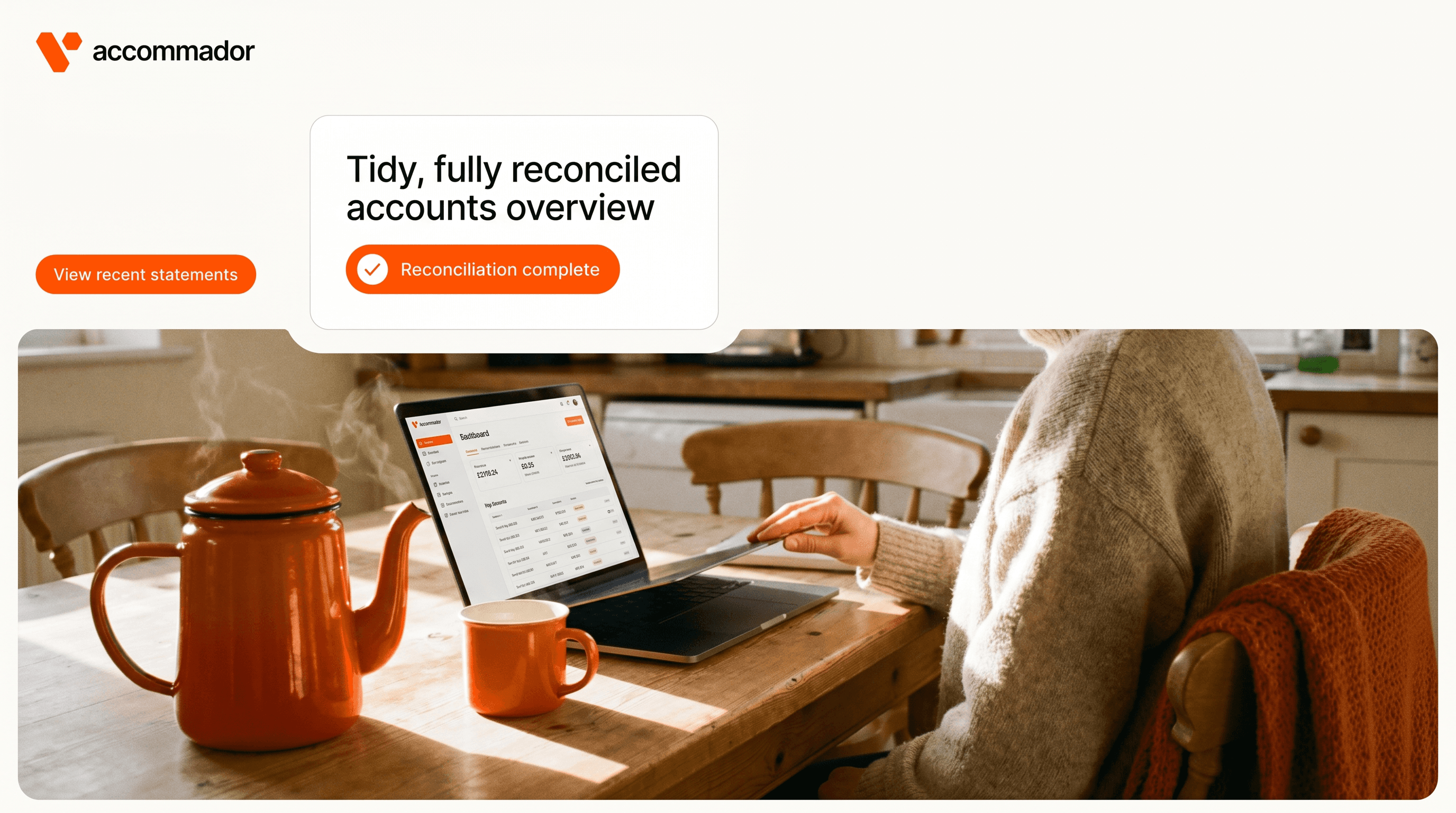
It doesn't have to. Accommador includes a self-reconciling Xero integration that creates the invoices, codes the revenue, and matches the payouts for you — part of the platform, not a paid add-on.
Why accommodation reconciliation is harder than normal bookkeeping
A café takes a payment and the job is done. Accommodation isn't like that. A single booking can split across a deposit now, a balance later, a security-bond hold, and a refund — sometimes spanning two months and two payment methods.
Then multiply that by your channels. A guest who books direct pays you straight through Stripe. A guest from an OTA might be paid to you net of commission, on a delayed remittance, in a lump sum that bundles five reservations together. By the time it hits your bank feed, the deposit no longer looks anything like the booking value.
That's the part that makes the job a chore: it's not the volume of transactions, it's the mismatch between what a guest agreed to pay and what eventually lands in the account. Doing it manually means three tabs and a matching game until the numbers reconcile.
What "self-reconciling" actually means
Self-reconciling accounting isn't magic — it's four jobs done automatically that you'd otherwise do by hand.
Auto-invoicing. When a booking is confirmed, the invoice is created in Xero without you touching it. Deposit and balance are raised as the guest pays, so your accounts always reflect what's genuinely owed and what's settled — not a backlog you reconstruct later.
Multi-account mapping. Accommodation revenue isn't one number. Room nights, cleaning fees, extras and bond holds often belong in different accounts or tax codes. Mapping routes each line to the right place on the way in, so your P&L is already structured when you open it — no monthly re-coding.
Deep links between a booking and its Xero record. Every booking points straight to its invoice, and every invoice back to its booking. When your accountant queries a line in June, you click through to the exact reservation instead of scrolling a spreadsheet — a five-second answer instead of a thirty-minute hunt.
Payout matching. This is the Sunday-killer. Stripe pays you net of fees in batches; the integration matches each payout back to the bookings inside it and reconciles the fee as an expense automatically. You stop manually splitting one $4,200 deposit across nine guests and a processing charge.
Put together, the goal is simple: the bank line and the booking line tick themselves off, and you review exceptions instead of re-keying the whole month.
What this looks like across an operating month
Run the conservative maths on a 30-room property. Say you average 120 bookings a month across direct and OTA channels. Manual reconciliation at even two to three minutes per booking — finding it, matching the payout, coding the fee — is four to six hours a month, almost always landing on a weekend because that's the only quiet window.
Automate the invoicing, mapping and payout matching, and that collapses to a short review of the handful of transactions that genuinely need a human eye: a partial refund, a disputed charge, a bond that was captured rather than released. You're checking exceptions, not building the whole reconciliation from scratch. That's the Sunday you buy back.
It also removes a quieter cost: errors. Hand-matching across channels is exactly where a deposit gets coded to the wrong account or a fee gets missed, and those small slips are what turn a 20-minute BAS check into an afternoon with your bookkeeper.
Why it's built into one platform
Because the booking engine, channel manager, payments and accounting all live in one login and one bill, there's no export-import dance between systems. The booking that created the charge is the booking that created the invoice — which is what makes the deep links and payout matching reliable rather than best-effort.
It works the same whether you're a 5-room B&B or an 80-room motel. A small operator benefits from auto-invoicing as much as a larger one — arguably more, since smaller teams have no spare hours for weekend reconciliation. And it applies across every booking: a reservation from a connected OTA carries its own invoice and link, rather than living only in a channel report.
The reason a self-reconciling Xero integration is built into Accommador is that reconciliation is where independent operators quietly lose a weekend a month — so marketing, booking engine, OTA distribution, payments and Xero reconciliation all sit in one place. From $500 AUD/mo per location, everything included. Monthly billing, cancel anytime. Start free.