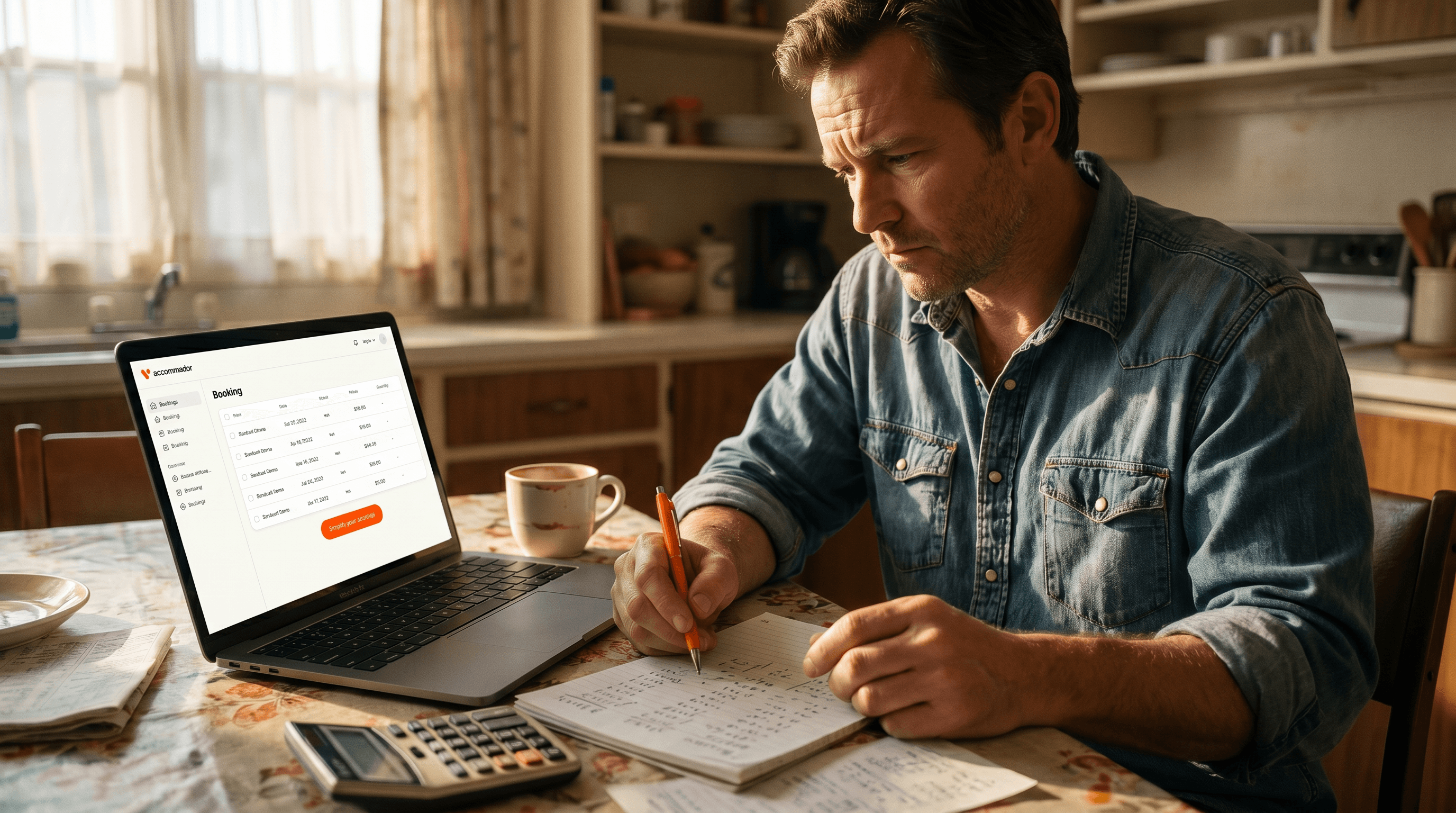
Most operators feel the commission bite every month but never sit down with the actual figures. You see the payout summary, you wince, and you move on to the next fire. The number stays a vague ache rather than a line you can act on.
To find what OTAs really cost you, run one line of arithmetic: ADR × nights sold via OTAs × commission %. For a 30-room motel at an $180 average daily rate, 75% occupancy, with 45% of room nights coming through OTAs at 15% commission, that is roughly $54,000 a year handed to the channels. Often a good deal more.
This article gives you the full, runnable maths so you can replace the example numbers with your own and see your real exposure in about two minutes.
The napkin math, step by step
- Here is the calculation in full, using a representative 30-room motel:
- Rooms: 30
- Average daily rate (ADR): $180
- Occupancy: 75%
- Room nights sold per year: 30 × 365 × 0.75 = 8,213 nights
- Total room revenue: 8,213 × $180 = $1,478,250
- Share of bookings via OTAs: 45%
- OTA revenue: $1,478,250 × 0.45 = $665,213
- Commission rate: 15%
- Annual commission paid: $665,213 × 0.15 = ~$99,782
Wait — that is not $54,000. It is nearly $100,000.
The lower figure assumes a more conservative OTA share. If only 36% of your room nights flow through the channels (still common for a property that does some direct and some walk-in trade), the same motel pays ~$54,000/yr. Both numbers are real depending on your mix. The point is the lever you control: commission paid = OTA revenue × commission %, and OTA revenue is the part you can shrink.
- Run it on your own property. You need four numbers you already know:
- Your ADR (check your last quarter's average).
- Your occupancy.
- The share of nights that arrive through OTAs.
- Your commission rate.
Multiply them through. Whatever you land on is money leaving the building every year — much of it avoidable.
The 15–18% range, and why it creeps up
In Australia, standard OTA commission typically sits in the 15–18% band. The headline rate is rarely the whole story:
Base commission is usually 15%.
Visibility and "preferred partner" programs layer on extra percentage points to push you up the search results — pushing effective rates toward 18% or higher.
Genius / loyalty discounts and member rates quietly shave your net further on top of the commission.
Re-run the napkin math at 18% instead of 15% and the 30-room motel's bill on that $665,213 of OTA revenue jumps from ~$99,782 to ~$119,738 — a $20,000 swing from three percentage points. Small rate creep is expensive at volume.
The honest part: some commission is fair
This is where the conversation has to stay honest. OTAs are not a scam — they are a billboard. They put your property in front of travellers who would never have found you otherwise, in markets and languages you cannot reach alone. For a genuinely new guest who discovered you on a channel, paying 15% to acquire them can be perfectly fair. That is a marketing cost, and a reasonable one.
- The leak is not the commission itself. The leak is paying that commission on the wrong bookings:
- The guest who would have booked direct but clicked the channel because it was top of mind.
- The repeat guest who stayed last year, loved it, and still went back through the OTA — costing you 15% on a relationship you already own.
- The would-have-booked-direct researcher who found you on Google, checked the OTA price out of habit, and converted there.
This is the billboard effect — the channel takes credit (and commission) for demand it did not create. The fair move is to keep paying for the genuinely new guests and stop paying for the ones you already earned.
Where the silent leak hides: min-stay searches
There is a second, quieter cost that never shows up on a commission invoice — because the booking never happens at all.
If your property runs minimum-stay or fixed-arrival rules (and most motels, cabins, lodges and villas do over peak periods), here is the failure mode: a guest searches dates that miss your rule by a night. Most booking engines simply return "no availability." The guest does not know they were one night off — they just bounce. And where do they go? Straight to an OTA, where they often find the same property bookable, or a competitor's. You pay commission on a booking your own engine could have won, and you never even see it leave.
Accommador's minimum-stay engine handles this differently: instead of a dead end, it surfaces the three nearest bookable dates and keeps the guest on your branded site. That is a booking captured at 0% commission that would otherwise have leaked. This is the single biggest reason the napkin math understates your true exposure — the lost bookings are not in your data because they never landed.
How you claw the commission back
Reducing OTA commission in Australia is not about ditching the channels — it is about shifting your mix toward direct and stopping the avoidable leaks. The levers:
- A branded booking engine that converts the direct visitor instead of dead-ending them. Every direct booking is a 15–18% saving on that night.
- An included 100+ channel manager so you keep the billboard reach without paying separately for it.
- The minimum-stay engine that catches min-stay searches and wins bookings your old engine was silently losing.
Server-side ad attribution so you can finally see which Google and Meta dollars produce direct bookings — measurement that has been broken since Apple's ~7-day cookie cap in 2021.
The economics are straightforward. On Accommador the minimum-stay engine, branded booking engine, 100+ channel manager and full marketing suite are not split across tiers — they are all part of the one platform, from $500 AUD/mo per location. Set that against the ~$54,000–$100,000/yr our example motel pays in commission. You do not need to win back all of it. Converting even a modest slice of would-have-booked-direct and repeat guests to your own engine covers the platform many times over.
A conservative reality check
We have kept these numbers deliberately middle-of-the-road. Your ADR might be higher in peak season, your OTA share might be 50%+ if you are newer or in a competitive region, and your effective commission might already be at 18% with visibility boosters switched on. Each of those pushes your real bill up, not down. The $54,000 figure is the gentle end of the range.
For context on the headline rate: standard OTA commission in Australia sits in the 15–18% band, with Booking.com generally starting around 15% and rising as you opt into visibility programs that boost your ranking. Always check your own contract — opt-in boosters and loyalty discounts can lift the effective cost well beyond the number on the page. Run your own numbers before you assume the channels are a fixed cost of doing business. They are not.
The reason the minimum-stay engine, branded booking engine, 100+ channel manager and direct-sales marketing all live in one platform is simple: clawing back commission only works when the engine that captures the direct booking, the channels that keep the reach, and the attribution that proves it are wired together rather than stitched across six separate tools. From $500 AUD/mo per location, everything included. Monthly billing, cancel anytime. Start free.