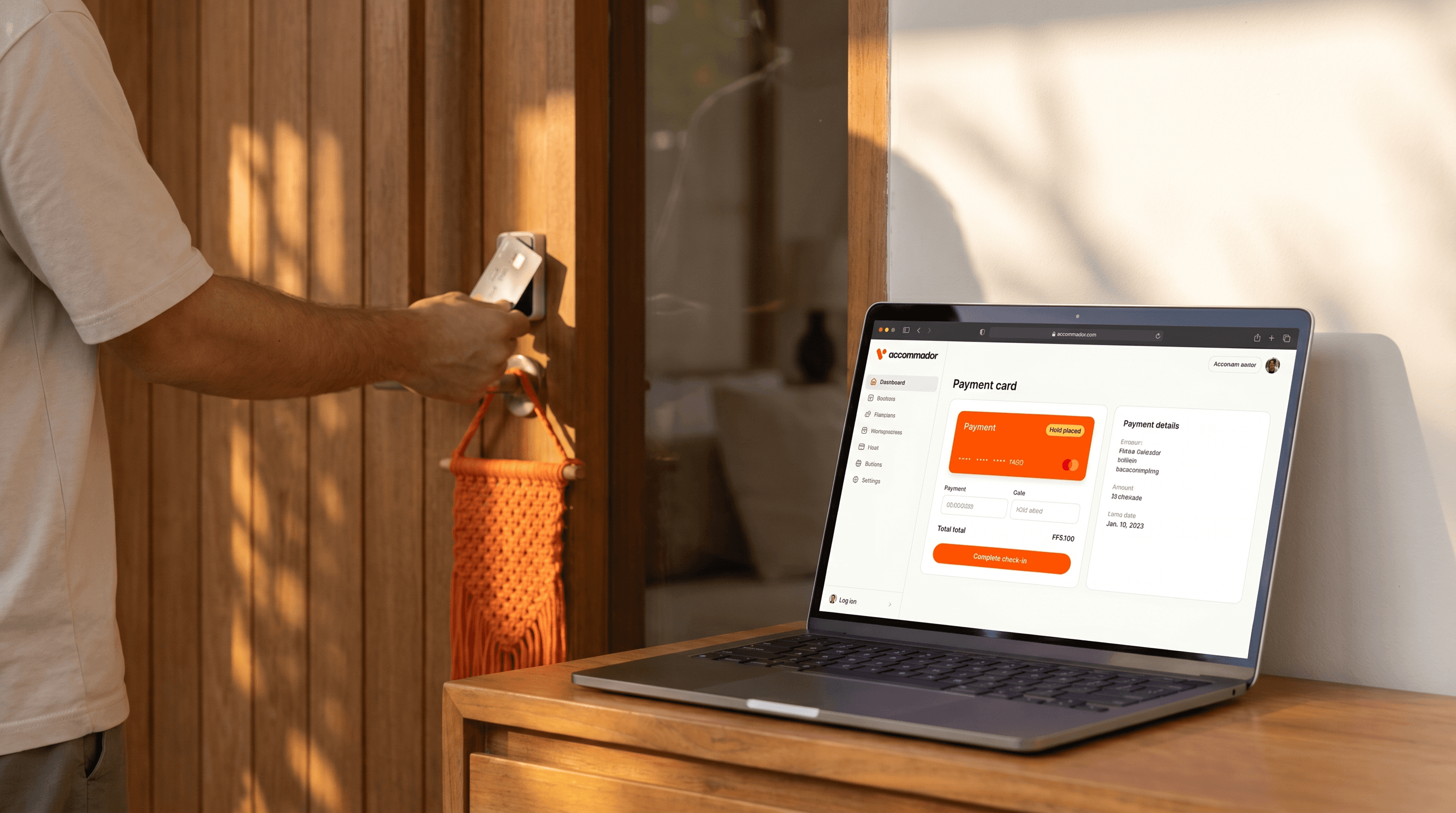
A guest books a $2,400 weekend on a Murray River houseboat. Then, days before they arrive, another $500 leaves their account for the security bond. That's $2,900 gone before they've stepped aboard — and the first thing they do is email you asking when they'll get it back.
If you run a houseboat, villa, lodge or self-check-in property, the deposit is your only real protection against damage and extra cleaning. But the mechanics of how you hold it decide whether the guest feels respected or robbed — and whether you eat fees and chargebacks. Most operators are still stuck on the old charge-then-refund method. There's a better way, and it's a pre-authorisation hold.
A pre-auth places a temporary hold on the guest's card without taking the money. You capture only what you need if there's damage, and release the rest automatically. That's the right way to run a security deposit.
Charge-and-refund vs pre-authorisation: the difference that matters
There are two ways to handle a security bond on a card. Charge-and-refund takes the full deposit as a real payment, then refunds it after checkout. It looks simple. It isn't.
- The guest sees a real debit leave their account — often hundreds of dollars — days before arrival.
- You pay card-processing fees on the charge, and depending on the processor you may not get those fees back on the refund.
- Refunds can take 5–10 business days to land. The guest is out of pocket the whole time.
- Every refund is a fresh transaction that can fail, get disputed, or trigger a chargeback.
- Pre-authorisation places a temporary hold instead. The bank ring-fences the amount against the guest's available balance, but no money moves.
- If the stay is clean, you release the hold and it simply disappears — usually within a few days, no refund transaction at all.
- If there's damage, you capture only the amount you actually need, up to the hold.
- You're not paying processing fees on money you were always going to give back.
- For a busy owner-operator, pre-auth is fewer fees, fewer disputes, and far fewer "where's my deposit?" emails.
Why pre-auth is fairer to the guest and safer for you
Back to that $2,400 houseboat weekend. The guest does not want a $500 deposit charged on top. With a pre-auth, the $500 is held but not taken — their statement shows a pending hold, their actual balance covers the trip, and the hold lifts after checkout.
That single difference removes most of the friction around deposits. Guests stop disputing the hold because nothing was actually charged. And because a clean checkout ends in a release rather than a refund, you're not filing dozens of refund transactions a month — each of which is a small chargeback risk.
On the operator side, the protection is stronger, not weaker. The funds are verified and reserved on the card the moment you place the hold. If you need to capture for a cracked benchtop or a deep clean, the money is already secured — you're not chasing a guest who has long since driven home.
Why self-check-in and houseboats/villas need this most
The properties where this matters most are the ones where nobody meets the guest at the door.
Houseboats and villas carry real damage exposure — hull scrapes, flooded galleys, broken hot tubs, missing linen. The bond has to be large enough to matter, which makes a charge feel punitive and a hold feel reasonable.
Self-check-in properties have no front desk to take an imprint or settle up at departure. The pre-auth becomes your damage policy, enforced automatically at booking.
Boutique motels, cabins and lodges running back-to-back changeovers can't afford to manually chase deposits between every stay.
When there's no human checkpoint, the booking flow is the deposit process. It has to place the hold cleanly, hold it for the stay, and resolve it without you touching anything.
International guests: Alipay and WeChat Pay
Australian accommodation gets a lot of international guests, and a deposit method that only understands Visa and Mastercard quietly loses bookings. Accommador's payments run through Stripe and PayDollar, with PayDollar adding Alipay and WeChat Pay — the wallets a large share of inbound guests actually use.
That means you can take the booking and hold the bond using the guest's preferred method, rather than forcing them onto a card they may not have. For operators in inbound-heavy regions like Port Douglas or the Gold Coast hinterland, that's the difference between a confirmed direct booking and a guest bouncing to an OTA.
How Accommador handles security-bond holds
Security-bond holds are built into the booking flow alongside everything else, so the deposit isn't a bolt-on — it's part of how a direct booking is taken. Here's the lifecycle:
Place. When the guest books through your branded booking engine, the bond is pre-authorised on their card or wallet at the same time as payment. No separate deposit email, no manual request.
Hold. The amount stays reserved for the stay. The guest sees a pending hold, not a charge. Holds typically sit for several days and release automatically if not captured — and because Accommador places the hold at booking and resolves it at checkout, the hold covers the stay and lifts shortly after the guest leaves.
Capture or release. Clean checkout? The hold is released. Damage? You capture only what's needed.
Because Accommador also runs self-reconciling Xero, the captures, releases and booking payments flow into your accounts cleanly — you're not hand-matching deposit transactions at month-end.
It's all in one login and one bill, alongside the channel manager, the minimum-stay engine and the marketing suite.
What this replaces
Plenty of operators bolt a separate deposit tool — or a manual spreadsheet and a card imprint machine — onto a booking engine that can't hold a bond itself. That's another subscription, another reconciliation, another thing to get wrong at 9pm during a changeover. A typical 30-room operator already runs 6–9 tools costing $1,000+/mo. Folding the security bond into the same platform that takes the booking removes one of them.
The reason security-bond holds are built into Accommador is that the deposit only works if it's placed and resolved inside the same booking flow that takes the payment — no separate tool, no manual chasing. The whole closed-loop direct-sales engine — marketing, booking engine, OTA distribution, payments and Xero reconciliation in one place — is from $500 AUD/mo per location, everything included. Monthly billing, cancel anytime. Start free.