Here's the uncomfortable truth most operators miss. The guest who lands on your direct site already wants to book with you. They've seen you on Booking.com, they've decided, and they've gone looking for your own site to skip the middleman.
Then something on the page makes them hesitate — and a hesitating guest is a guest who clicks back to the platform they already trust. You never see the loss. You just see "they booked on the OTA again."
There are three trust gaps that cause it, and every one of them is something you control. Fix the three below and the ready guest has no reason left to bounce.
Why guests book on Booking.com even when they prefer you
The OTAs have spent billions teaching travellers that their checkout is safe. Free cancellation in plain sight. A padlock and a logo they recognise. A confirmation email that arrives in seconds. A booking flow they've completed a dozen times.
So when a guest reaches your site and the experience feels even slightly less certain — a clunky widget, a stock photo, a price that looks the same as the OTA's, a form that fights their phone — their brain does the maths and picks the known quantity. That's why guests book on Booking.com despite preferring you: not loyalty, but trust friction on your side.
The good news is that all of it is fixable.
Trust gap 1: a booking engine on your own domain — not a third-party-looking widget
This is the big one. A guest who clicks "Book Now" and gets thrown to a different domain — a pop-up, a frame, a checkout that suddenly looks nothing like your site — feels the handoff. The URL changes. The branding changes. For a split second they're not sure whose checkout they're in, and uncertainty at the payment step is where bookings die.
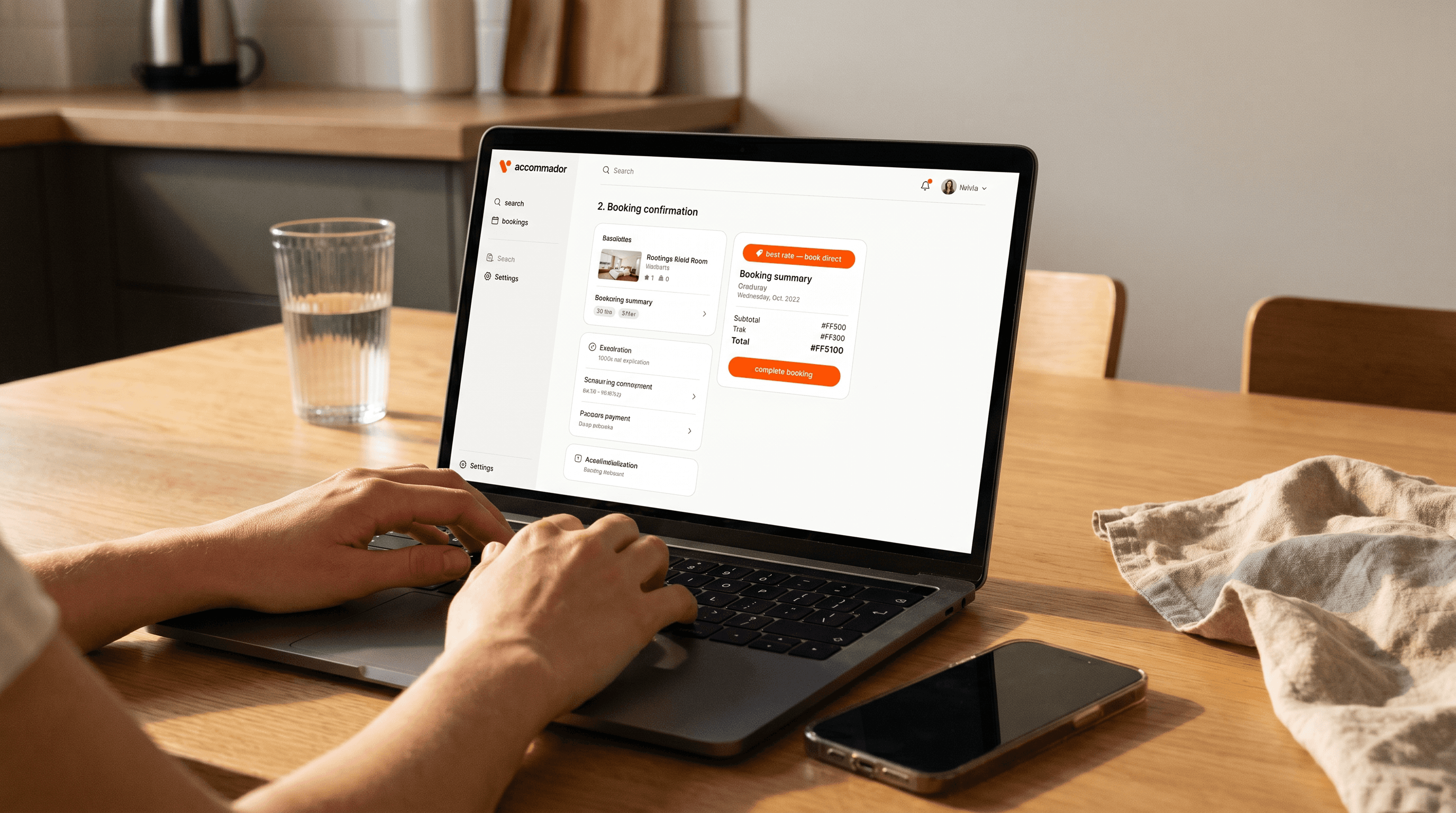
A branded booking engine keeps the guest on your domain, in your colours, with your name on every screen from search to confirmation. No visible handoff. No "powered by someone else" that makes a careful guest wonder who's actually taking their card.
Accommador's booking engine is Accommador's own and runs as part of your branded site — not a stitched-on third-party tool. Payments run through Stripe (and PayDollar, including Alipay and WeChat), so the security guests expect is there without the experience ever leaving your brand.
- Run the checklist on your own site:
- Does "Book Now" keep the guest on your domain, or punt them to a different URL?
- Does the checkout carry your logo, your colours, your property name on every step?
- Is there a recognisable secure-payment indicator at the card step?
- Does the confirmation email come from you, not a generic third party?
- If any answer is "no," you have a handoff a guest can feel — and on mobile, where most browsing now happens, the seam shows even more.
Trust gap 2: real photos and a genuine best-rate-direct guarantee
Two things make a guest believe booking direct is the smart choice rather than the risky one: seeing exactly what they're getting, and knowing they won't pay more for the privilege.
Real photos. Not stock. Not a single hero shot recycled across every room type. Travellers compare your direct site against the OTA listing side by side — and the OTA listing usually has more photos, guest snaps, and detail. If your own site shows less than the platform does, you've handed the guest a reason to trust the platform more than you. Match it: every room type, real rooms, the actual view, the actual bathroom.
A genuine best-rate-direct guarantee. This is the single clearest reason for a guest to book with you instead of the OTA — but only if it's real and stated plainly. "Book direct for our best rate" next to a price that's identical to Booking.com convinces no one. The guarantee has to be true, visible, and specific.
- The checklist here:
- Multiple real photos per room type, including the views and the bathrooms?
- A best-rate-direct line that's actually honoured — and a direct rate that genuinely beats or matches the OTA after commission?
- Your cancellation terms stated as plainly as the OTA states theirs?
- Any perk for booking direct (early check-in, a welcome extra) named on the page?
Remember the maths behind the guarantee. Every OTA booking costs you 15–18% in commission. A direct booking keeps that. So a best-rate-direct guarantee isn't generosity — it's keeping the commission you'd otherwise hand over, and sharing a slice of it with the guest as the reason to choose you. When it's real, it pays for itself.
Trust gap 3: a fast, mobile, frictionless flow that matches the OTA
The OTA checkout is ruthlessly optimised: few taps, big buttons, no dead ends. If your flow is slower, fiddlier on a phone, or hits a wall, the guest reverts to the experience that just works.
The worst dead end is the silent one. A guest searches their dates, your engine says "no availability," and they leave — even when you do have rooms, just not in the exact pattern they typed. This bites hardest for operators with minimum-stay or fixed-arrival rules: a guest searches a 2-night stay against your 3-night minimum, sees "no availability," and bounces straight to an OTA. You never even know the booking existed.
That's the direct-booking leak, and it's the most expensive trust gap of all because it's invisible. Accommador's minimum-stay engine handles it differently: instead of a dead "no availability," it surfaces the 3 nearest bookable dates that fit your rules and wins the booking that would otherwise have walked.
- Check your flow:
- Does the flow load fast and work cleanly on a phone, thumb-first?
- When a guest's dates miss your min-stay or arrival rule, do you offer the nearest bookable dates — or just say "no availability"?
- How many taps from "Book Now" to confirmation? Fewer is better.
- Does the guest get an instant confirmation, like the OTA gives them?
- Match the OTA on speed and friction, remove the dead ends, and the ready guest has no reason left to click back.
What this looks like as one platform
Closing all three gaps with separate tools is how most operators end up with a clunky direct site in the first place — a widget from one vendor, photos managed somewhere else, a payment page from a third. The seams are the trust gap. It's the familiar 6–9 tool, $1,000+/mo stack, and every join between those tools is a place a guest can feel the handoff.
Accommador puts the branded booking engine, payments, the minimum-stay engine and a 100+ channel manager in one login, one bill — so there are no seams for a guest to trip over. The reason all three trust signals are built into one platform is simple: a guest only trusts a checkout that feels like one continuous experience, start to finish.
From $500 AUD/mo per location, everything included. Monthly billing, cancel anytime. Start free.