A guest is on your site at 9pm, sold on the river views and the restored 1890s rooms, ready to book three nights over a long weekend. They click Book Now. The checkout that loads is a different colour, a different layout, and the address bar flips to a domain they've never heard of. They pause. They open a new tab. They check the OTA price instead. You never see that booking leave, because as far as your reports are concerned, nothing happened.
A branded booking engine runs the entire reservation — dates, room choice, payment, confirmation — on your own domain, in your own brand, with no redirect to a third-party-looking checkout. A guest who never leaves your site, never sees an unfamiliar logo at the payment step, and never hits a "no availability" dead end is a guest who books direct.
Most "direct booking software" in Australia ships a generic embedded widget — an iframe or pop-up that loads from someone else's domain and looks nothing like the rest of your site. It works, technically. But it quietly costs you bookings at every step. Here's what a true branded engine does differently, and what to look for when you're choosing one.
What "branded, on your own domain" actually means
There are two very different things sold under the same "booking engine" label.
A generic widget is a snippet you paste into your site. When the guest clicks "Book Now", the checkout loads inside a frame served from the vendor's domain — often with the vendor's styling, the vendor's URL flashing in the address bar at payment, and a layout that doesn't match your pages. The guest can feel the seams.
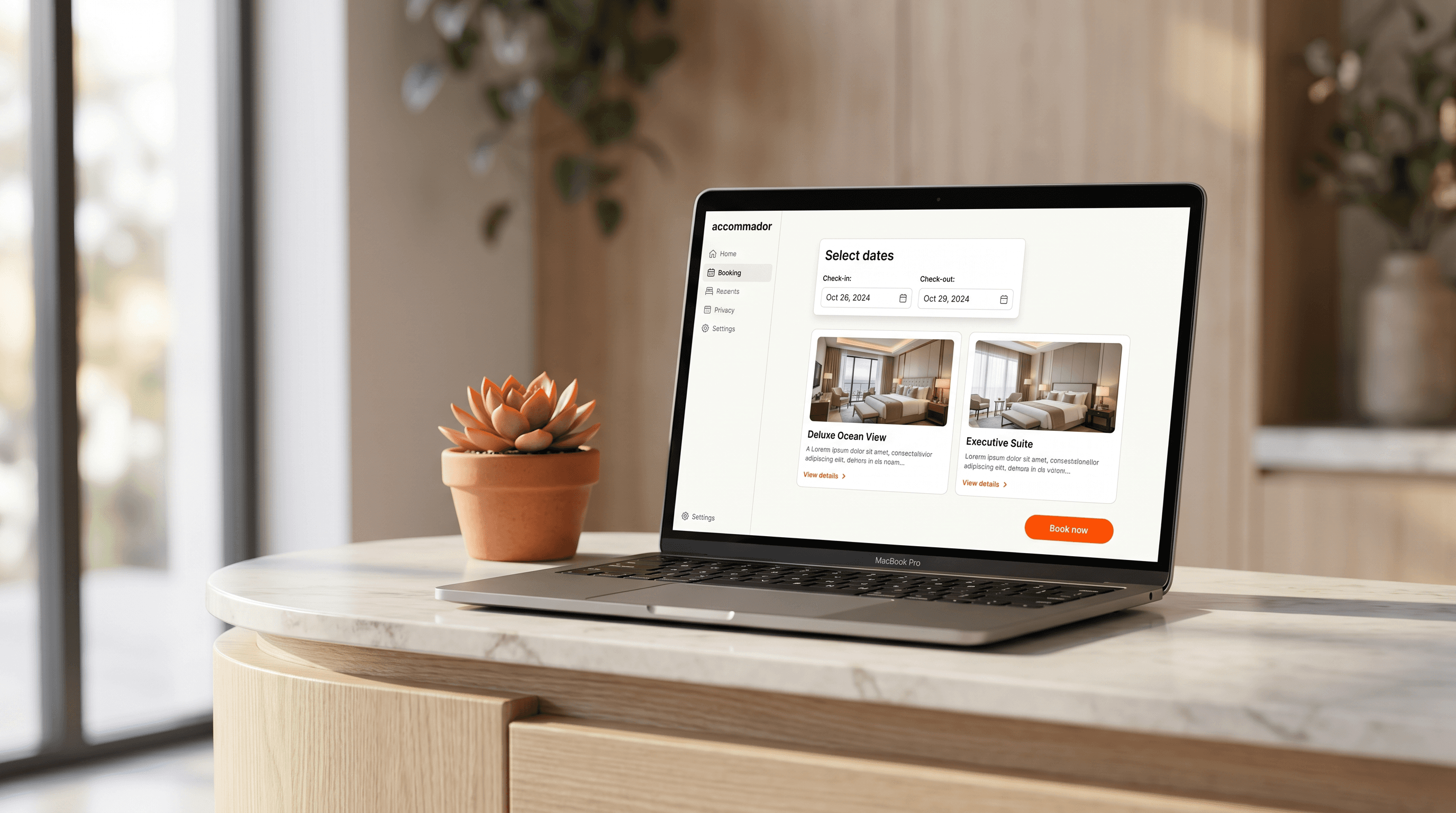
A branded booking engine runs on your domain (book.yourlodge.com.au or /book on your own site), inherits your colours, fonts and logo, and keeps the URL and the experience yours from first date-search through to the confirmation email. Nothing about the flow signals "you've left this business's website."
That continuity isn't cosmetic. It's the single biggest lever on whether a ready-to-book guest actually completes — and it's why the engine type, not just the price, is what you should be comparing.
Why the branded engine converts better
Trust survives the payment step. The moment a guest is asked for a card, they look for reassurance: is this the same business I was just reading about? A generic widget breaks that — a different domain and unfamiliar branding at the exact instant trust matters most. A branded engine keeps your name, your domain and your design all the way through, so the guest never has a reason to pause, open a new tab, and "just check the OTA price instead."
Brand continuity stops the comparison reflex. Independent operators win on character — the river views, the restored rooms, the host who actually knows the region. A generic widget flattens all of that into a beige form the instant the guest tries to book. A branded engine carries your story into the booking flow, so the guest is still buying your place, not just a room. That continuity is what keeps them from reflexively price-checking on a channel.
Mobile speed. Most accommodation searches now happen on a phone, often on patchy regional reception. Embedded third-party widgets add another domain to connect to, more scripts to load, and more chances to stall on a slow connection. A native branded engine loads as part of your own site — fewer round trips, fewer moving parts, a faster path to "Confirm". On mobile, every extra second of load is bookings lost.
No jarring redirect. The redirect to a checkout that looks like it belongs to a different company is where a lot of direct intent leaks away. A branded engine removes it entirely. The guest stays put, the URL stays yours, the confirmation arrives from you. Smooth flows finish; jarring ones get abandoned.
It wins the min-stay searches a generic widget loses
Here's the leak almost no one measures. Many operators run minimum-stay or fixed-arrival rules — three nights on a long weekend, Saturday-only arrivals in peak season. When a guest searches dates that don't fit the rule, a generic booking engine simply returns "no availability". The guest assumes you're full and bounces — usually straight to an OTA, where they may book a different property entirely. You never see the lost booking, because as far as your reports are concerned, nothing happened.
Accommador's restricted-stay engine handles this the opposite way, and it's built into the platform rather than gated behind a higher tier. Instead of a dead end, it surfaces the three nearest bookable dates that satisfy your rule, keeping the guest in your flow and converting a near-miss into a confirmed direct booking. That single behaviour — bookable dates instead of a dead end — is often the difference between a recovered weekend and a guest lost to a channel for good.
A buyer's lens: what to look for
When you're shopping for a hotel booking engine in Australia, the marketing all sounds the same. These are the questions that actually separate a branded engine from a dressed-up widget:
Does the checkout run on my domain, or theirs? Click through a live demo and watch the address bar at the payment step. If it switches to the vendor's domain, it's a widget.
Can it apply my min-stay and fixed-arrival rules — and what does it show when a search misses them? "No availability" is a fail. Surfacing the nearest bookable dates is a win.
Is it genuinely my branding, or a theme picker? Logo, colours, fonts, and the confirmation email should all be yours, end to end.
How does it load on a phone on weak reception? Native beats embedded every time.
What does it actually cost, and is that price on the page? Most of the market gates pricing behind "request a demo." If you can't see the number before you talk to sales, assume it's higher than you'd like.
Is the channel manager included, or another bill? A booking engine that doesn't include channel sync is only half the job — and the second bill adds up fast.
Where Accommador fits
Accommador is an all-in-one direct-sales platform for independent Australian operators, and the branded booking engine is included — alongside the PMS, a 100+ channel manager, Stripe payments and Xero reconciliation, in one login and one bill. There's no tier to climb to unlock it.
The restricted-stay (min-stay) engine that wins the searches a generic widget loses is included too, as is the full marketing and CRM suite, security-bond pre-authorisation holds, and conflict detection across your channels. A typical 30-room operator today is paying for six to nine separate tools — channel manager, PMS, booking engine, email, SMS, reviews, social, site and funnel — that add up to roughly $1,000+/mo. Accommador does more than that stack, in one place.
The reason the branded engine, the channel manager and the min-stay logic are all built into one platform is simple: a direct booking only completes when the whole path — search, brand, payment, confirmation — stays yours and never hits a dead end. From $500 AUD/mo per location, everything included. Monthly billing, cancel anytime. Start free